Showing posts with label Fame. Show all posts

Thursday, January 14, 2016

Developing Memory Trends

There are a few new types of memory breaking onto the scene that are reportedly going to change the world.  The trick to bringing a memory technology to the commercial market today is nailing all 4 key properties: fast, dense, non-volatile, and inexpensive.  
  1. Normal DDR3 DRAM is fast (6-20 nanoseconds) and dense, but volatile and expensive at $50/GB for enterprise server DRAM.
  2. NAND flash is dense, non-volatile, and inexpensive (~$5/GB for enterprise SSD), but it's nowhere near the speed of DRAM at >50,000 nanoseconds
  3. Memristors sound amazing, but they don't exist yet and likely won't in the next 5 years.  
  4. 3D Xpoint appears to be the the only viable option right now.  Intel and Micron report it is:
    1. Fast: 1,000x faster than Flash would mean 50 nanosecond range.
    2. Non-volatile
    3. Up to 50% less expensive than DRAM
    4. 10x denser than DRAM
Importantly, 3Dxpoint is reported to be durable.  One of the drawbacks of Flash is writes cause damage to it over time, so if you start with a 1TB disk after 4 years you may have a 200GB disk.  To solve this, manufacturers pack up to 6x the needed amount of Flash into an SSD so when an area goes bad, the SSD just allows you to write to a brand new area of the disk.  This does two bad things: drives up cost and drives down performance. 
"We show that future gains in density will come at significant drops in performance and reliability. As a result, SSD manufacturers and users will face a tough choice in trading off between cost, performance, capacity and reliability."  Source
If 3dxpoint delivers on its promises, there will be several huge impacts.
  • All-3dxpoint arrays.  Today's storage operating systems will need to be completely re-written as they are simply not capable of going from 50,000ns disk latencies to 50ns.  
  • All systems will have more memory.  At 50% the cost of DRAM, rather than spend less money on memory we'll probably just spend the same money on 2x the amount of memory.
  • Because you'll have 2x the memory, operating systems will need to be re-written.  Our current OS's are designed around the cost constraints of memory gradually declining according to Moore's law.  3dxpoint would thrust us forward along that line and require serious software engineering to take advantage of it.
  • Since it's non-volatile, operating systems will need to be re-written.  Lose power?  Start right back where you left off.  This means you wouldn't be able to resolve an application/OS freeze-up with a hard reboot as well.
  • FaME (Flash as Memory Extension) will give way to 3dxpoint as Memory Extension and accelerate the trend rapidly.  The cost of 3dxpoint ($25/GB?) make a strong case for the shared-resource model of today's data storage industry, while the performance and non-volatility feature would be the succession of SAP HANA's "database in memory" architecture (and IBM's Spark, too).  
DRAM's performance advantage over 3dxpoint probably means DRAM won't go away in the enterprise.  Rather, 3dxpoint would be another tier of memory, below DRAM and above disk, with DRAM mirrored to the 3dxpoint for its non-volatility.  

Wednesday, January 13, 2016

Top of Rack Flash and FaME


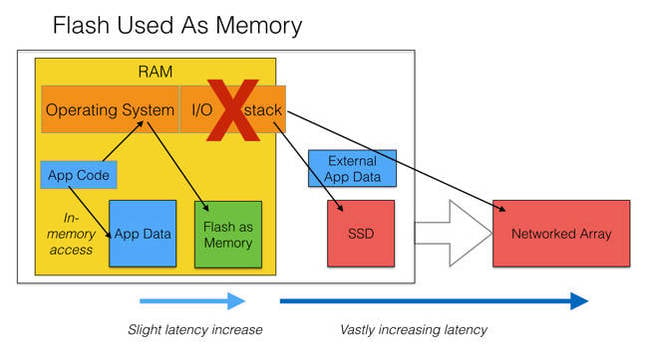
One developing topic is Flash as Memory Extension, or FaME.  With flash becoming cheaper and cheaper and CPU's getting faster and faster, there's an architectural bottleneck to solve: there's a huge performance gap between the DRAM and the SAN.  

FaME tries to solve this by accessing SSDs in way that mimics access to RAM, skipping the SCSI stack and driving down latency.  This begins to close the DRAM-SAN gap, achieving latencies in the 500-900ns range.  There are a whole host of ways to accomplish this.
  • NVMe is one, essentially a PCI-slot compatible SSD.  Pop it in a server and it acts like DRAM.  The disadvantage here is you've re-introduced the problems the SAN/NAS was introduced to solve: stranded capacity, lack of data protection features (snapshots, replication), and you'll need to come up with a way to make this NVMe available to multiple nodes for parallelization and redundancy. Think Fusion-IO, which also required significant re-coding of applications.
    • RoCE Infiniband has port-to-port latencies ~100ns
    • RoCE Ethernet has port-to-port latencies ~230ns and RoCE v2 is routable.  This is a link-layer protocol, however RoCE v2 is not supported by many/all OS's yet. 
  • iWARP is a protocol that allows RDMA wrapped in a packet for a stateful protocol like TCP.  
  • Memcached is an open-source way for your servers to use other servers as DRAM extension.  I'm a bit fuzzy on whether it simply uses the second server as a place to put part of your current working set or if it offloads portions of the computation as well.  In any case, here's a good explanation.
  • HDFS, key value store semantics and other protocols: this may be the smartest way to do things, just let the application speak directly to a storage array the same way it would speak to RAM.  
Currently the fastest all flash SAN/NAS arrays have latencies in the 100,000-200,000ns range.  This is miles away from the DRAM, which is in the 6-20ns range.  FaME is aiming for 900ns.  Architectures like HANA and Spark try to solve this by putting the entire workload in DRAM, which is expensive and means that a power outage requires long process of re-loading the data from disk into DRAM.  
Courtesy of http://www.theregister.co.uk/2015/05/01/flash_seeks_fame/

Looks like FaME will be a good price/performance solution until we develop a super-cheap static RAM.